
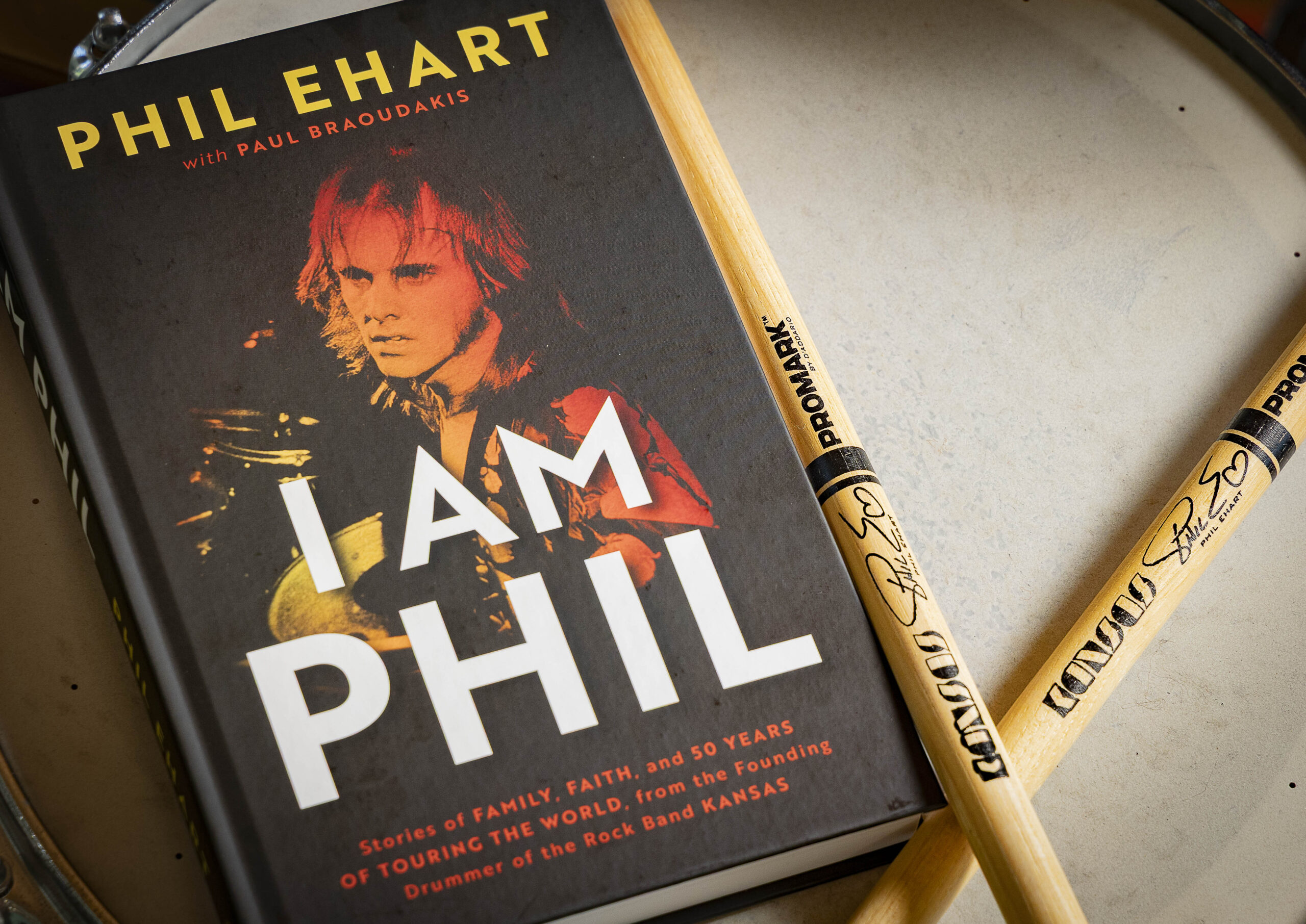

For more than five decades, Phil Ehart has kept time behind the drum kit for Kansas, the Topeka-born rock band whose songs, including “Carry On Wayward Son,” “Dust in the Wind,” and “Point of No Return,” became the soundtrack of a generation. What most fans never knew is that Ehart’s story off the stage rivals anything the band ever put on vinyl: chance encounters with several of rock music’s most iconic figures, and a lifetime shaped by a military childhood that carried him from Air Force bases in the Philippines to a club in New Orleans.
Now, after decades of people telling him he ought to write a book, and after the long road of recovery from a major heart attack, Ehart has finally put it all down on paper. His new memoir, I Am Phil, co-written with Chicago-based writer Paul Braoudakis, arrived earlier this year after a writing process that began in earnest in 2024, just months after the cardiac event forced him, for the first time in his life, to slow down.
“You keep hearing it, and you keep hearing it, and finally you go, ‘Okay, I’ll write one and see how it goes.’”
That was Ehart’s answer when asked what finally convinced him to share his memoirs. The tipping point, he said, was a conversation with Braoudakis, who had been pursuing the project since discovering an old email from 2011 in which he’d first pitched the idea. The timing had never worked, until it did.
“He got me,” Ehart said of his co-author’s approach. “He said, ‘Why don’t you write these stories down for your kids? Because your kids are going to want to know these stories.’” When he mentioned the idea to his daughter, Avery, her reaction sealed it. “She replied to Laurie, ‘Oh, Mom, I would love that. Get it done.’”
A Reluctant Subject
For a man with gold and platinum records lining his walls, Ehart is remarkably uninterested in talking about himself, a trait his wife, Laurie, describes as central to who he is. Sitting down to reconstruct a lifetime of stories, he said, forced an unfamiliar kind of self-reflection.
“I don’t take myself that seriously,” Ehart said. “I don’t really sit around and think about myself that much. I have way too much else going on.”
That reluctance, paired with the physical and emotional toll of recovering from a heart attack, made the writing process difficult at times and, according to Laurie, deeply valuable. “I feel like it was one of the best things you did for your recovery,” she told him during the interview, “trying to stop and just take a look back. You don’t usually do that.”
The finished product surprised even its author. “As it started to form into a book, I told Laurie, this is actually pretty interesting,” Ehart recalled. “Once you start seeing it and reading it, it’s actually pretty good.”
Faith, Clearly Stated
Ehart was insistent from the outset that his Christian faith be represented honestly in the book, even though it plays no role in Kansas’s music today. “My relationship with Jesus is extremely important to me,” he told Braoudakis early in the process, “and if it’s not important to you, then I’ve got the wrong guy.” Braoudakis, he said, embraced the idea immediately.
Readers quickly learn how much it means to Ehart to have been raised in a family of faith. At a young age, he came to understand and accept the good news of who Jesus was and the sacrifice He made for everyone. To this day, Ehart considers himself blessed and chooses to live as a Christ follower, emulating Jesus in his own understated, humble way.
In I Am Phil, Ehart writes, “Some may be surprised by that because I haven’t shouted it from the rooftops or worn it on my sleeve. But it’s as real as anything else in my life.”
The subject carries some complicated history for the band. In the 1970s, one member’s embrace of Christianity, reflected heavily in the lyrics he was writing, created friction within the group, though nothing that threatened its survival. Ehart carefully frames the chapter as personal testimony rather than proselytizing. “It’s not, I’m judging anybody or tearing anybody down,” he said. “It was about my personal faith.”
Brushes With Rock History
Some of the memoir’s most vivid material predates Kansas altogether. Early in his career, Ehart played in a New Orleans bar band called the Pets when a club owner pulled him aside: Jim Morrison was at the bar, and the Doors frontman wanted to sit in.
“He wants to talk to you on a break, because he wants to try out some new lyrics with you guys playing,” Ehart recalled the club owner telling him.
Morrison came up during a break, sang a few verses of new material over “Light My Fire,” gave Ehart a thumbs-up, and walked out into the French Quarter. Not long after, Morrison’s manager booked Kansas as an opening act for what turned out to be the singer’s final performance before his death in 1971.
That same era produced an equally unforgettable moment with Janis Joplin, who called Ehart over after a Kansas set at the New Orleans Pop Festival. “She said, ‘I’m gonna tell you something. You’re great. Don’t you ever quit,’” Ehart remembered. Decades and multiple platinum records later, he still credits that brief exchange as one reason he never gave up during the band’s leanest years. It was a period, he noted, when the group survived on roughly a dollar a day and cases of canned soup that his mother mailed him to keep him fed.
A Painful Story About a Friend
Not every story in the book is triumphant. One story he was quick to recount, one that had never been made public before, involves Rush drummer Neil Peart, a close friend and peer whose career rose alongside Kansas’s in the mid-1970s.
Peart, now widely regarded as belonging on the “Mount Rushmore” of rock drummers, once asked Ehart, who had an endorsement deal with drum manufacturer Slingerland, to help him secure one of his own. Ehart made the call on Peart’s behalf, only to be told the company wanted nothing to do with it, not because of Peart, but because of friction with another member of Rush. Ehart had to deliver the news himself.
“He had to sit down. I mean, it was heartbreaking for him.”
“I would have given him my own drum set if I could have,” Ehart said. The two remained close for the rest of Peart’s life; Peart died in 2020. Ehart said he still isn’t entirely sure why the story had never come out before it was marked for inclusion in the book. “All the Rush fans heard about it for the first time ever,” he said. “They didn’t know that happened.”
Honoring the Fallen
Perhaps the memoir’s most personal chapter grew out of Kansas’s long relationship with the USO, an outgrowth of Ehart’s own upbringing as the son of a career Air Force officer. Ehart spent years organizing tours that brought musicians to aircraft carriers and overseas bases, an effort he describes, only half-jokingly, as inventing “the first airborne rock and roll division.”
That work eventually led the band to Section 60 at Arlington National Cemetery, the burial ground for U.S. service members killed in Iraq and Afghanistan, on a visit arranged by a longtime fan and military veteran. The experience inspired a song of the same name, which the band began performing live as a nightly tribute, inviting a local service member to hold a folded flag onstage while the lights dimmed.
“We’re taking this time out of our set each night to honor those that have given their lives. What happens when we’re done? We get booed.”
The reaction, Ehart clarified, came from a single California audience, an outlier in what has otherwise been an overwhelmingly supportive response from a fan base the band has come to rely on through five decades of career turns.
Built by Chance
Woven through the book is a recurring theme: how much of Ehart’s life turned on chance encounters rather than planning. Kansas itself, he said, was never engineered; it was a handful of self-taught neighborhood friends from Topeka, the majority of whom could read sheet music, who happened to click. Even the band’s breakout Pennsylvania fan base, still its strongest region decades later, traces back to a last-minute booking after Queen had to cancel a Pittsburgh date and promoter Rich Engler slotted Kansas into the headline spot instead.
“That’s how you get your big break,” Ehart said. “Just by chance.”
What Readers Will Take Away
Asked what he hopes readers carry away from the book, Ehart returned to the same theme that runs through nearly every story he tells: gratitude for a career built on luck, faith, family, and a fan base he doesn’t take for granted.
The book is available through Ehart’s website, PhilEhart.net, and locally at Smith & Davis Clothing, the longtime Fayetteville, Georgia, store whose owners became fans after discovering the book on a visit. Early sales, Ehart said, have exceeded his expectations, as has the response from younger readers who arrive expecting the familiar excesses of a rock memoir and instead find something different.
“They couldn’t believe you could go through those decades without drinking and doing drugs,” Laurie said. “It’s just a story of Phil’s life. Very different.”
For a musician who has spent 50 years avoiding the spotlight off the stage, that reaction may be the truest measure of what the book set out to do.
CONTACT DETAILS
Book: I Am Phil by Phil Ehart with Paul Braoudakis (Whirlwind Publishing House, 2026)
Website: PhilEhart.net
Local retailer: Smith & Davis Clothing, 1552 Highway 54 West, Fayetteville, GA 30214, (770) 487-4183
By Craig Threlkeld
Leave a Reply